

~~~~~~~~~~~~~~~~~~~~~~~~~~~~~~~~~~~~~~~~~~~~~~~~~~~~~~~~~~~~~~~~~~~~~~~~~~~~
Connect with your Union. Go to 7102 Contacts/Email to find out how.
Local active member meetings are 6:30 PM on the 2nd Thursday. May not be scheduled every month.
Local retiree member meetings are 2:000 PM on the 2nd Thursday. At union hall and online via Zoom.
2000 Walker St. Des Moines 50317

Expanded links to Benefits & Services in our Resource Info section. We have all the links you may need.
They are right here when you need them.
Latest on Retiree News go to the Local News section
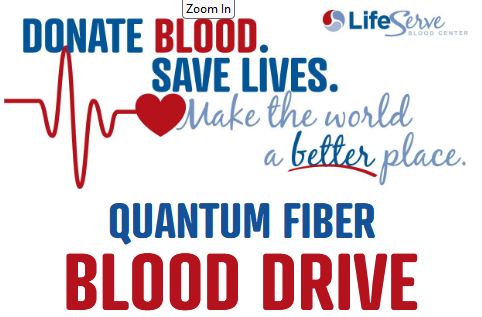
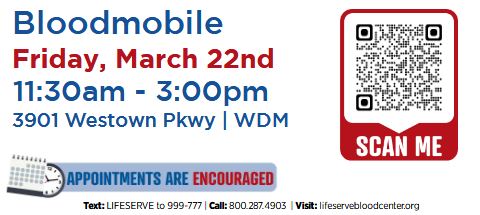
We have a blood drive coming up on the 22nd of March.
Click on
the below banners for more information. 


<>

| Today
in Labor
History Labor history is OUR history. The stories of the struggles of working people in this country and around the world to make a better life for themselves and their children and all of us – people who work for a living – are often unknown and untold. Today in Labor History is all about helping to bring those stories to light. Engineering & Operations in the Bell System (AT&T) *** (Book) "PDF" https://drive.google.com/.../1HRpkpstcBCeHXmsNytS.../view... Second Edition Reorganized and Rewritten Telecommunications in the Bell System in 1982-1983  Volume 1 - Principles
(1977) AT&T (Book) "PDF"
 Volume 1 Principles, covers the transmission engineering principles that apply to communication systems... It defines the characteristics of various types of signals, describes signal impairments arising in practical channels, provides the basis for understanding the relationships between a communication network and its components and provides an appreciation of how transmission objectives and achievable performance are interrelated. And the CWA Active Members Party held at 6 PM   Time to pick for the prizes  Time to do some cooking.  You can attend retiree meetings via Zoom.
It's just so very easy.
Download Zoom https://zoom.us/download if you don't already have it. After
that you just click on the meeting zoom link on the Central Iowa CWA Retiree Committee
site and you get right in. Hey it's fun to be involved.
You can even do it on your cell phone. Just install the Zoom app.    ------------------------------------------------------------------------------------------------------------------------------------ At the Union Labor Park, on Monday, September 4, 2023. The Party after the Labor Day Parade in Downtown Des Moines, Iowa. +76 pictures Shared
by Jeannie McCrea
Go
to the shared post |



 Big Benefits. Really big savings. Big Benefits. Really big savings.Do you want to save a bunch of money? Of course you do. Go to UNIONPLUS |
(New)
Hospitals take aim at Medicare Advantage
Medicare Advantage may now provide health coverage to more than half of the nation's seniors, but that is not stopping health systems from pushing back against the growing and controversial program.
Hospitals
have been dropping Medicare
Advantage plans over high claim or prior authorization denial rates
since at least 2018, but it was an uncommon move until recently. Some
systems have noted that most MA carriers have faced allegations of
billing fraud from the federal government and are being probed by
lawmakers over high denial rates. (click on the above link for more
info)
Picture taken at local union meeting. Looking good guys.

| Michael Thompson |
Jerry M. Uhlman |
Jim Perkey |
Mark Rocha |
 Next Generation
is a network of thousands of union members 35 and under in all
districts and sectors who are mobilizing in support of CWA’s mission
and goals. By contributing to CWA’s core programs—including CWA
Strong, Human Rights, Organizing, and Political Action—and
strengthening our ties with local, regional, and national allies, we
are building a robust foundation for the future of the labor
movement. Follow Next Gen on
Next Generation
is a network of thousands of union members 35 and under in all
districts and sectors who are mobilizing in support of CWA’s mission
and goals. By contributing to CWA’s core programs—including CWA
Strong, Human Rights, Organizing, and Political Action—and
strengthening our ties with local, regional, and national allies, we
are building a robust foundation for the future of the labor
movement. Follow Next Gen on
Click to connect to the Iowa Federation of Labor

To be the best site to find the latest information on matters that effect our members.
Copyright © 1997-2024 CWA Local 7102 All rights reserved.
Copyright, disclaimer and legal information.
If
you have an email at
cwa7102.org and use GoDaddy or Microsoft Outlook to access it
and have a question please contact Don Dawson for assistance.
The webmaster of cwa7102.org does not have access to GoDaddy or Outlook.
He can connect you with the union in house IT person.
Direct technical issues regarding this site to the Webmaster.
and have a question please contact Don Dawson for assistance.
The webmaster of cwa7102.org does not have access to GoDaddy or Outlook.
He can connect you with the union in house IT person.
Direct technical issues regarding this site to the Webmaster.